Tuesday, September 1, 2020

Vocabulary Instruction: Try Word Riffs


Many young readers hit a wall when their reading demands that they decode longer and longer words. Research has shown that instruction in morphology (roots and affixes) can help readers make this transition. Some excellent resources are available for teaching morphological understanding. One that I particularly like is the Word Ladder approach of  Dr. Tim Rasinski. Word Ladder books for various grade levels are readily available from Scholastic, but lately Tim has been posting Word Ladders on his Twitter feed. You can follow him @TimRasinski1 to get his latest freebies. 

I have had success with a variation on the Word Ladder, adding an element of the Think Aloud, in my own teaching. I call it, for lack of a better term, the Word Riff. The idea of the Word Riff is to help students use morphology in decoding, expand student vocabulary, and turn students on to the richness and logic in the English language. 

The Word Riff grows out of each student's Vocabulary Self-Collection Notebook. As a part of the student's interactive notebook they keep for my class (a place for reflections, reading responses, notes, etc.) I ask the students to collect new, unknown, and interesting words they run across in their reading. The student is asked to identify the word, the context (sentence) the word was found in, a best guess definition of the word, and a dictionary definition of the word. If you would like to read more about the Vocabulary Self-Collection Strategy, please see this readwritethink lesson.

Each day I ask student volunteers to share words they have discovered and then the class decides which word they would like to learn more about. It is at this point the Word Riff begins. Essentially, I take the word and talk about its roots, prefixes, suffixes, derivation, and other words which use the same or similar root. In one class a student brought in the word "signatory." The student, doing some research on local history (4th grade), had come across this sentence:

"George Clymer was an early American advocate for revolution and a signatory of both the Declaration of Independence and the U.S. Constitution."

The student told the class he learned from the dictionary that "signatory" meant "signer." So Clymer was a signer of the Declaration of Independence and the Constitution.

I took it from here, writing the word, the sentence, and the definition on the board, I began as follows:


"As you can see, boys and girls, both "signatory" and "signed" come from the same root word, in this case the Latin "sign" which means mark or seal. The first thing I notice is that we hear the "g" in signatory", but the "g" is silent in "sign." One thing we need to learn about the English language is that sometimes spelling is preserved to carry the meaning of the word, even if that spelling does not match the way the word sounds. So the silent "g" in "sign" lets us know that this word is related to making a mark. Speaking of making a mark, right away I am sure you noticed that "signatory" is close to "signature." When you put your signature on your assignment you place a mark that lets me know whose paper it is. And there is the word "assignment", meaning some work that you must do or literally leave your mark on it to signal that it is yours. Notice that "signal" also comes from the same root, so that we know to stop working and look to the front when I signal with two fingers in the air. 

Going back to "assignment" for a minute, we might notice the prefix "as-", which indicates something that happens, and the suffix "-ment" which signals that this word is a noun. Some of you may be aware of the insignias that indicate the various houses of Harry Potter's Hogwarts such as Gryffendor. An insignia is a special design that designates membership in a particular group. Notice that the "g" is silent in another "sign" word "design" and then we hear the "g" again in "designate." In both cases the prefix "de-" meaning to set apart. So a design, like an insignia sets you apart as a member of a certain group and when I call on you or designate you to do something, I am also setting you apart with a special "sign."

Finally, I think it is significant that we talk about one more use of the root "sign" that may come up in our reading. I am speaking of course of the word "significant" meaning important. As in, "Your study of roots and prefixes and suffixes is significant." It is important. I would not want to waste your time with teaching you words that were insignificant. I am sure that you can see that by adding the prefix "in-" to significant I have made the word change from "important" to "not important" at all" because the prefix "in-" in this case means "not."


As I am doing this Think Aloud, I write the highlighted words on the board and underline prefixes and suffixes as appropriate. 

Not all words that children come up with lend themselves to so full a discussion of roots and affixes as this one, but many do. Other examples include man- (as in manufacture, manuscript, manual. manipulate, manager, manumission) and graph-  or gram- (as in graphic, autograph, photograph, grammar, telegram) Chrono- (chronic, chronological, chronograph, chronicle, synchronize). Here is a resource for many, many more.

What I want to communicate to children is that words are fun, fascinating, and surprisingly logical in their construction. I want them to know that when  big words are broken down into their component parts they are not so intimidating. I want them to know the joy I take in discovering new words and in discovering ways that words are connected to each other. 

Tuesday, August 25, 2020

The First Day of School in a Pandemic


In my lifetime, I have experienced 67 first days of school. For me this has always been a joyous time. When I was a student, it was a chance to renew old acquaintances, meet new people, and start new adventures. As a teacher, I always looked forward to meeting and getting to know new students and learning their names and what made them tick and seeing if the new crop of kids would fall for my old jokes and tricks.  This 68th first day of school will be different, of course. My thoughts are with every child who must navigate this strange new world, every teacher who must find a new way to teach, every administrator trying to make this work without putting children and adults at risk, and every parent trying to do a god job of parenting in this new and unfortunate reality.  

This is a frustrating, maddening time for all, but we owe it to the children to make the best of it we can. We owe it to the children to lead with empathy and understanding. My granddaughter, Schuyler, robbed of a large chunk of her kindergarten year, now faces a first grade like nothing you or I or our children ever faced. I worry for her. I worry for all these kids. It is with Schuyler and all these other children in mind that I offer this poem, written many years ago, in a different time and under different circumstances, that I still think captures some of what it means to entrust your child to a teacher and some of what we must draw on in this time of uncertainty.

The First Day of School
            
by Russ Walsh

Today, dear teacher, I deliver to you
            my heart, my life, my son.
He’s not perfect:
One day he’s noisy,
Next day he’s careless,
Next day he’s both.
            Treat him kindly;
            Guide his growth.

I assure you, dear teacher,
            you’ll learn his name quickly.
He has his opinions.
He speaks them loudly,
Displays them proudly,
So sure he’s right.
            Respect his feelings:
            Harsh words can bite.

I should warn you dear teacher,
            he has no patience for seatwork.
But he’s not lazy,
Just likes to ponder,
And let his mind wander
In every which way direction.
            Value his thinking;
            Allow reflection.

Today dear teacher, I deliver to you
            my heart, my life, my son.
I ask that you listen.
I ask that you watch.
I ask that you care.
            And give him a hug,
            When I’m not there.


So take good care of the children, take good care of yourself, lead with kindness, and be assured this too shall pass.


Monday, August 17, 2020

Phonics, Fluency, and Flexibility


If you have ever read one of Peggy Parrish's delightful Amelia Bedelia books to young children, your efforts were no doubt greeted by howls of laughter. Children delight in the word play involved when Amelia "dresses the turkey" in coat and pants, or when she "pitches a tent" by throwing it poles and all, into the bushes. The children's delight comes, of course, from the humor derived from Amelia's totally literal understanding of words and the children's growing knowledge that words can have more than one meaning. If you are reading these books to first and second graders you may also notice that some children are not in on the joke. They may laugh along with others, but they may not yet have the cognitive flexibility to get the joke. 

Cognitive flexibility is defined as the ability to switch between thinking about two different concepts or to think about multiple concepts simultaneously. If you can't switch between two different concepts of "dress" or "pitch" you can't get the humor of Amelia Bedelia. Likewise, if you can't switch between two or more different concepts about how words are constructed, you will have great difficulty becoming a fluent reader. Recent research indicates that cognitive flexibility contributes to beginning reader's fluency, that low achieving readers lack cognitive flexibility, and perhaps, most importantly cognitive flexibility can be taught. (See References Below)

When you think about this it makes good sense. Phonics knowledge can only get us so far in decoding. If children approach every unknown word with only the "sound it out" strategy to help them, they will only be able to decode the most rudimentary words and will not achieve fluency in reading. Sounding out will work effectively enough for a words like "sun" or "moon" or even "June", but even here students must have the flexibility to see two different ways to represent the "oo" sound. What about the word "fight?" Sound it out won't work here, so the child must move to the analogy strategy: "I know the word "night" and this word ends the same, and it start like "fun", so it must be "fight"." 

Then when children move to multi-syllable words, new challenges present themselves. Compound words like "strawberry" or "baseball" may be fairly straightforward, but what do we do with a word like ""previewed?" Here children must apply their morphological knowledge: "I know "pre" is a suffix meaning "before" and "-ed" is a suffix indicating past tense." And then there are words like "cover" and "covert" and "model" and "motel" where flexibility is given a real workout. Here the reader must try an approximation of the word, using knowledge of closed and open syllables, and then try to determine what sounds right and makes sense in the context of the reading (Best guess and check).

Summing all this up would indicate that a fluent reader must flexibly and strategically use a combination of strategies to decode an unknown word.  Students who consistently use only the "sound it out" strategy will find that too many English words don't map easily to letter by letter decoding and that the fluency necessary for sustained comprehension eludes them. "Sounding out" is a necessary skill, but applying it too rigidly will hinder the development of fluency.

Children need to develop a "What could I try?", mentality when approaching unknown words. Teachers can help them develop this strategy through modeling. Modeling can perhaps best be achieved through the think aloud. While reading aloud to children the teacher stops at a variety of pre-planned points in the reading to model decoding strategies. Placing the target word on chart paper or white board can help to demonstrate the strategies being used. The teacher can model flexibility by trying different strategies and by orally labeling the strategies as "sound it out" or "analogy" (some say "compare" strategy), "morphology" or "word parts" or "best guess and check." 

When following up with individual readers, the prompt, "What could you try?" can be used to remind readers that a variety of strategies are at hand to help them. An  anchor chart in the room can be used to help readers see that a number of decoding strategies are available to them at all times.

Some children seemingly come by their flexibility in approaching reading problems naturally. Other children need systematic instruction to help them discover the many routes they may take into a word. Our language is rich and complex and often defies attempts to govern it with rigid rules. While that richness and unpredictability may be frustrating to young readers, Peggy Parrish shows us in her Amelia Bedelia books that that very richness and unpredictability can also be a great source of joy and humor. 

References

Cartwright, K.B., et al., (2019).  Executive function in the classroom: Cognitive flexibility supports reading fluency for typical readers and teacher-identified low achieving readers. Research in Developmental Disabilities. retrieved from https://www.sciencedirect.com/science/article/abs/pii/S089142221930023X Aug. !5, 2020

Chard, D., Pikulski, J., Templeton, S.(2000). From phonemic awareness to fluency: Effective decoding instruction in a researchbased program. NY: Houghton Mifflin. retrieved from https://www.eduplace.com/state/author/chard_pik_temp.pdf August 15, 2020

Pascale, C., Duncan, L., Blaye, A. (2104). Cognitive flexibility predicts early reading skills. Frontiers in Psychology. retrieved from https://www.ncbi.nlm.nih.gov/pmc/articles/PMC4052802/ Aug. 15, 2020.


Monday, August 10, 2020

Reading Instruction at a Distance: Read Aloud, Read Along, Read Alone, Read Again


Whether teaching at a safe distance in school, or online, or some combination of the two, teachers and students face a unique challenge this year. While reading instruction for our most vulnerable readers will necessarily look much different from normal practice, many best practices can still be used effectively. An instructional design I would recommend is Read Aloud, Read Along, Read Alone, Read Again. Let's take a look at these four elements and see how we can use them in this brave new teaching world.

Read Aloud

This well-documented and effective reading strategy can and should remain central to our distanced instruction. Read aloud is not only a pleasurable activity for most, but it also builds student vocabulary and background knowledge, provides a model of fluent reading for children, and provides the teacher with opportunities to model reading comprehension strategies like predicting, summarizing, rereading, adjusting reading rate, and questioning.

During this pandemic, while I haven't been able to visit my grandchildren, I have been recording video  read alouds and sending them off to be shared at bedtime. Teachers can choose to do recorded read alouds or real time read alouds with their students this fall. For more on Read Aloud you can look here.

Read Along

As I wrote in a recent post you can find here, the read along is an assisted reading strategy that can be used with vulnerable readers to help them improve decoding, fluency, and comprehension. At its most basic, students follow along while a voice recording is played. The strategy was developed for use with third graders in the 1970s to help readers who struggled to get any pleasure out of reading because decoding was slow and laborious. Listening and reading along repeatedly helped students develop more fluency in their reading and with that greater fluency came greater comprehension.

Voice recordings of a wide variety of texts are now readily available. Amazon has an "Immersion Reading" program tied to its Kindle reader that is very promising. Apps like Hoopla and Libby connect students to local public libraries and their store of recorded books. Teachers, of course, can also make voice recordings of books that they want students to read along with.

Read Alone

We know that students spending time reading alone in a book that provides just the right amount of challenge is perhaps the single most effective reading experience we can provide. In the classroom, we would call this independent reading time, but at a distance, it might indeed be reading alone. Whatever the name, this is a critical activity in any reading instruction program. Our target should be to get all students to read at least 20 minutes on their own in a book of their own choice daily.

For a full discussion of independent reading and why it is so critical, you can look here. 

Read Again

The research in reading has long shown that re-reading a story, poem, or passage improves decoding, fluency, and comprehension. Re-reading is a particularly effective strategy for vulnerable readers, whose decoding may be slow and  demand so much attention that it interferes with comprehension. Using the book that the students are listening and following along with, teachers could ask the students to listen to the story over and over while following along until they can read it aloud with good fluency. If the story is a longer one, the students might be asked to choose one passage or paragraph to re-read until they are able to read it back fluently. As I will discuss below, poetry also lends itself very well to the read again strategy.

You can read more about repeated reading here. For an article that looks at repeated reading with poetry, you can look here.

Putting It All Together

While this instructional design could be used with any type of text, and while the same text does not have to be used for each type of instruction, here is one way that the design could be used in a unified way using poetry. Poetry is particularly useful for the strategy because whether teaching in-person or online a copy can easily be made available to all students. Poetry also lends itself to repeated reading and the rhythm and rhyme support fluency and decoding.

Here is a poem from my book, Snack Attack and other poems for developing fluency in beginning readers (Infinity, 2010).

The Rattling, Rumbling Train

The rattling, rumbling, rambling train
Travels through the sun and rain
From south of France to north of Spain;
Then turns and speeds right back again.

The rattling, rumbling, rambling train
Climbs the mountains, crosses the plains.
What might its boxcars each contain?
Perhaps some fruit or corn or grain.

The rattling, rumbling, rambling train
With cars linked in a giant chain.
I watch it pass, but can’t explain
The power it has to entertain.

The rattling, rumbling, roaring train
Makes noise that clatters through my brain.
But please don’t think that I complain,
I love that rattling, rumbling train.


In step one of the strategy, the poem would be read aloud to the child/ren. Prior to the read aloud, predictions might be gathered about the topic of the poem by reading the title or perhaps talking about times that children have watched a train roll by in front of their car. Some mention of different kinds of trains like passenger trains and boxcar trains might be helpful. After the read aloud, vocabulary like "plains" or "contain" could be discussed. Other topics for discussion could focus on onomatopoeia (rattling,, rumbling, clatter) or alliteration (rattling, rumbling, rambling) or even metaphor (the cars linked in a giant chain).

Step two would involve the children reading along in the text  while the poem was read aloud again. This could be done in real time by the teacher or recorded for the children to listen to later, Recording the poem has the advantage of allowing the children to read and listen repeatedly.

Step three asks that the children read the poem independently.

Step four has the reader returning to the poem and re-reading it. This re-reading could be done with a partner, if possible, or with a parent. If needed, the reader can listen to the taped recording of the poem repeatedly until a fluent reading of the poem is possible.

Follow up activities might include opportunities to write about reactions to the poem and/or sharing personal experience with trains in writing. Teachers might also want to spend some time discussing the -ain word family or blends and digraphs like "tr", "gr", "pl", "ch." that are a part of the poem.

It is, indeed, a challenging time. It is also a time when good reading instruction is possible. Most importantly it is a time to encourage students to improve their reading by continuing to read. Repeatedly.


Tuesday, August 4, 2020

What's In a Name Chart?


Sylvia Ashton-Warner's book, Teacher, first published in 1963, is a chronicle of her experience teaching Maori children in her native New Zealand in the 1940s and 50s. A major insight that Warner discusses in the book is the concept of "key vocabulary." She approached the literacy instruction of her children through the words that had special resonance for them, through their own experience, much of it fraught with poverty and violence. Warner had each child come to her each day with a word they wanted to learn and led the children though various activities to make sure they learned them. These words, drawn from the "inner life" of the child, were powerful to that child and, therefore, more easily learned.

We have all had similar experiences, I'm sure, with children who can read a word like "dinosaur" before they can read the word "they", simply because "dinosaur" is a powerful word for that child, a "key vocabulary" word, if you will. As Invernizzi and Buckrup (2018) put it, "The effects of experience are personal and profound" (p 92).

Over the years, research has demonstrated the efficacy of Warner's ideas. Perhaps none more so than the research of  Treiman and Broderick (1998) who demonstrated that the identity and characteristics of the first letter of a child's name has a significant effect on the child's knowledge of letter names. If we think about it, this makes perfect sense. What vocabulary is more key to the child than that child's own name. Children's strong attachment to their own names may help them in understanding how letters work in words, first within their own names and later, perhaps in other words (Rieben and Perfittii, 2013).

The research brings me to what I consider one of the most powerful instructional tools we can have in the primary classroom - The Name Chart.


As Benito and David and Matilda and Jayden learn to find their names on the name chart, they can also learn the shapes and sounds that those beginning letters make.  Later they may learn that Belen or Diego or Jessica or Morgan have names that start with the same letter. The powerful words on the name chart are a gateway for children to learn the alphabetic principal, that is, letters represent sounds and that those letters may be used in various combinations to make words.


Here are some other recommended uses for the name chart in the classroom.
  • As a spelling aid when doing shared pen or interactive writing activities. "This word starts like Zachary's name."
  • As a game as children come to sit for read aloud. "Touch your own name on the name chart and then sit down."
  • I'm thinking of someone whose name begins with "M." Who can come up and touch it?
  • Clap the names and count the syllables.
  • Do a shared reading of the names .pointing to each name as you read it in order or randomly.
  • Place cards with the names on them in the word study center and have children sort by first letter.
Our own name is our most powerful word. It makes good sense to guide children in their understanding of the alphabetic principal by showing them first how letters work in their own name.


Works Cited

Ashton-W.arner, S. (1986) Teacher.  New York: Touchstone.

Invernizzi, M.and Buckrup, J. (2018) Reconceptualizing Alphabet learning and Instruction. in Cassano, C. and Dougherty, S..ed., Pivotal Research in Early Literacy. New York: Guilford.

Rieben, L. And Perfitti, C.A. (2013). Learning to Read: Basic Research and Its Implications. Mahwah, NJ. Erlbaum.

Treiman. R. and Broderick V. (1998). What's in a Name: Children's knowledge about the letters in their own names. Journal of Experimental Child Psychology. 70, 97-113.


Monday, July 27, 2020

The Read Along: Assisted Reading for the Vulnerable Reader


In a post two weeks ago, Independent Reading in a Pandemic, I suggested that with all the problems the pandemic was causing, one positive was that it provided time for kids to do extended independent reading. One parent responded by asking, "What should my dyslexic daughter do, look at her books and cry?" Fair enough question. Many of my colleagues responded by suggesting this mother get her daughter listening to audio books. This is great advice. As my colleague, Stu Bloom suggested, apps like Hoopla and Libby connect students to local public libraries and access to audio books. For those who can afford it, Amazon now has an Immersion Reading Program which allows you to listen and read along on a Kindle or Smartphone while the device tracks the words.

While Amazon may call it "Immersion Reading", I prefer the term Carol Chomsky coined in her classic 1976 article, After Decoding, What?, "assisted reading." Chomsky wrote about her work with a group of third grade students who had had plenty of phonics instruction, but had not developed any fluency in their reading. She had the children read story books repeatedly while they listened to the story being read aloud on tape. She wanted the children to read the books over and over again until they could read them back to her fluently without assistance. Chomsky was searching for a method that would "capture their attention and make large amounts of textual material available" (p. 288). She determined that what these students needed was to "shift their focus from the individual word to connected discourse and to integrate their fragmented knowledge" (p. 289).

The students, of course, were not strictly "reading" in the traditional sense, but combining memorization with reading to capture a more fluent account of the text. This new found fluency allowed the readers to engage with the text in ways they were unable to before, so that they gained the pleasure of actually being able to understand the text and talk about it and write about it. Indeed, Chomsky found that these vulnerable readers took great joy in their accomplishments and that writing about what they had read increased their engagement and comprehension. She also found that the gains made in assisted reading resulted in a greater willingness to read in other environments and to choose reading as a "free time" activity.

Subsequent research has supported Chomsky's findings. Repeated reading has been shown to be an effective strategy for improving decoding, comprehension, and fluency. I have written about the strategy in The Power of Rereading and Reading Fluency: Building Bridges from Decoding to Comprehension. The leading expert on fluency instruction in the country, Tim Rasinski is also an advocate of Chomsky's methodology as he discussed in a blog entry on  The Robb Review, The Goal of Phonics Instruction is to Get Readers to Not Use Phonics When Reading. And as Rasinski notes, recent research by Stevens, Walker and Vaughn (2017) who were studying students with learning disabilities found that "assisted reading with audiobooks produced gains in reading fluency and comprehension" (p. 576).

Chomsky added some activities as follow up to the students repeated reading/listening to the stories. As I mentioned, having the students write about their reading seemed to play an important role in their progress. They wrote responses to the stories, answered questions in writing ,and made up sentences using words from the stories.

Chomsky also did some word work with the children after they had mastered the stories. When I was working as a clinician at the Rider University Reading/Writing Clinic, I also used this strategy to good effect. Chomsky took some index cards and cut a "word sized" window into them. She would then move the index card around on the text exposing just one word to see if the student could identify the word. If the student could, she moved on to another word. If the student couldn't, Chomsky picked up the card and the student could then read the full sentence and identify the word that way. The goal here was to supplement the rote recognition that came from memorization with the study of the orthographic features of the words. The idea was to keep the instruction light and game-like, but at the same time help the students look closely at the words and develop their understanding of how words work. 

Assisted reading, let's call it the read along, has proven to be an effective strategy for helping vulnerable readers. Today's technology makes the potential success for assisted reading as an instructional technique even greater. The need for strategies that vulnerable readers can do in the home during this time of pandemic and that is likely to engage them in more real reading makes assisted reading a particularly attractive strategy for the moment.

Works Cited

Chomsky, C. (1976) After Decoding, What? Language Arts, 53, 3, 288-296.

Rasinski, T. (2018) The Goal of Phonics Instruction is to Get Readers to Not Use Phonics When Reading. The Robb Review.

Stevens, E., Walker, M., & Vaughn, S.  (2017). The effects of fluency interventions on the reading fluency and reading comprehension performance of elementary students with learning disabilities:  A Synthesis of the research from 2001-2014. Journal of Learning Disabilities, 50, 576-590.


Monday, July 20, 2020

The First Question to Ask of a Vulnerable Reader


When I was six years old, I was given my very first "big boy" two wheel bicycle for Christamas. I loved it. I can still see it all shiny and red and huge by the Christmas tree. As soon as my Dad would let me, I took it out the side door into the driveway, leapt aboard (it was too big for my six-year-old legs)  aimed it down the steep drive, and rode it directly into the telephone pole in front of the house. I was banged up a little, the bike was fine and I quickly scrambled back on the bike and rode it, a bit unsteadily, up and down the sidewalk until I was comfortable and able to keep my balance without too much wobbling. I really wanted to master riding that bike. I rode it everyday after that until I was 16.

When my student, Ryan, was six years old, he came to me for reading instruction. Ryan had been identified by his kindergarten teacher as a possible candidate for Reading Recovery instruction. His first grade teacher confirmed the recommendation after doing an initial assessment of Ryan's literacy ability during the first weeks of school. I administered an observational survey, which confirmed the  recommendations of the teachers, and so Ryan joined me for one-on-one Reading Recovery instruction.

Ryan and I met daily for 20 weeks. During that time, Ryan made some progress towards being a reader, but the progress was not what I would have hoped and certainly did not help Ryan achieve the goal of being a self-sustaining reader. I pulled out all the stops with Ryan. My lessons, I thought, were well planned. I held a meeting with his family and followed up with phone calls, hoping to engage them in a partnership in helping Ryan. They were open and supportive of Ryan's efforts. I observed Ryan in the classroom, where he was receiving excellent instruction from the classroom teacher. When Ryan failed to make sustained progress, I asked my Reading Recovery trainer to come in and observe my instruction and make recommendations to help me help Ryan.

Despite these efforts, Ryan never thrived in our lessons. While Ryan was always friendly and compliant in the sessions, he never showed much enthusiasm for the instruction or for the stories or even for the progress he was able to make. After 20 weeks, I made the difficult decision to have Ryan referred for testing to the child study team, to see if special education placement was called for. I was frustrated and angry with myself for my lack of success. I hoped that Ryan would find success in another program, but I was not at all convinced he would.

As I reflect on this failure from the distance of 25 years, I think I failed Ryan in part because I failed to ask one simple question. It is a question I think many of us may fail to ask when we are given the job of helping a child learn to read. It is the first question I think we need to ask of any vulnerable reader who comes into our charge. The question is, "Does this child want to learn to read?"

For many children learning to read is hard work. In order to commit yourself to that work, you have to want to do it, just as I really wanted to be able to ride that bike. The desire to read is critical to learning to read. While most children come to school with a burning desire to read, some vulnerable readers do not. There may be many reasons for this, but the reasons are not as important as our awareness that this may be the case and then taking some action to help children develop the desire to read. I want to be clear here. I am not talking about a child who reads little or who is difficult to motivate to read, I am talking about a child who is not interested in learning how to read..

To understand how to help kids who don't have a desire to learn to read, we need to look at why most kids do want to read. It is likely a combination of  factors including: a desire for a ticket into the adult world, a feeling of accomplishment, curiosity about topics like dinosaurs or sports or superheroes, an interest in words and how they work, an interest in stories, and a desire to please the adults in their life.

Based on this list, some of the things we can do as teachers to foster a desire to learn to read are obvious and others, perhaps, not so obvious.

Conversations - Individual and on-going conversations with the child on their own hopes, dreams, interests, activities, can help the teacher build both an understanding of the child and clues to what might be motivators for learning to read. A pet, an obsession with dinosaurs, an interest in trucks, an ability on art. Conversations may provide some keys to the child's desires.

Regular Read Aloud - Read alouds should be from high quality books that integrate pictures and words into rich and complex stories and informational texts on topics of interest to the child.

Book Talks - The teacher should be talking about books and other materials she has read,sharing the richness that is the adult experience of being a reader.

Experiences with Book Tie-Ins - Field trips are obvious ways to provide experiences for developing interest in learning to read, but everyday experiences like walks around the building, or videos on particular topics are great experiences where the teacher can recommend books that tie-in to the topic. The best model I have seen for this type of video is Reading Rainbow.

Think Aloud - The teacher models how she processes a text. This can often be done during a read aloud as the teacher stops and talks about her building understanding of the text and fixes up any confusions that happen along the way. This is also a good time to try to develop a curiosity about words by talking about vocabulary that comes up and modeling different ways that readers figure out the meanings of words. Discussions about words and their endless fascination should be a regular part of dialogue with children who are not yet showing an interest in learning to read.

Specific Praise - Anytime our reluctant reading learner does something reading related it should be met with praise that specifically points to desirable reading behaviors. "Ryan, I noticed you looked at that book on dinosaurs to see if it had some information you are interested in. Good work."

Recommending Books - Knowing the child's interests you can recommend books to the child, place the books in the child's hand, point out pages of particular interest, send them home with the child, and ask about the book later.

Finally, I am not recommending suspending good reading instruction until our reluctant learner shows more interest. What I am recommending is that our reading instruction may be more effective if we focus a considerable amount of our literacy time with these children on developing the desire to read. That desire to read might just be followed by a desire for learning how to read. Once the child is receptive to the instruction, our chances of success are greatly enhanced.


Monday, July 13, 2020

Independent Reading in a Pandemic


We need to get books into our student's homes and hands.


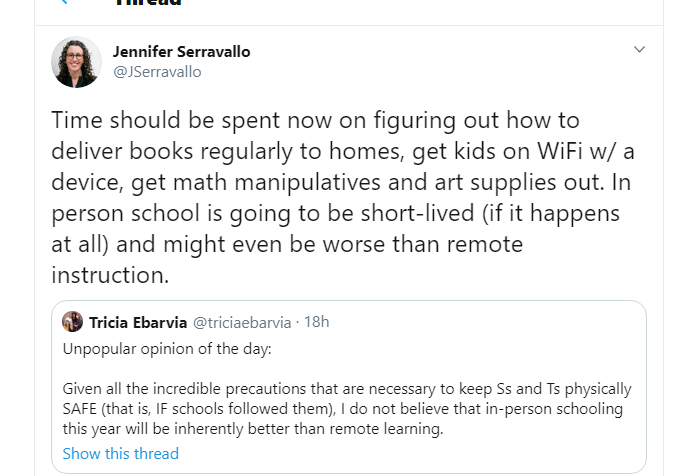
This tweet from the estimable Jennifer Serravallo appeared on my feed this morning. I believe she is right. Schools should not be forced to re-open and the likelihood that a forced re-opening will lead quickly to a renewed shutdown is high. Districts, school leaders and teachers should be preparing for more long-term distance learning. This situation, we know, is not ideal, but as my mother would say, if all you have is chopped meat, make meatloaf. In this case, if we can't meet with our students eye to eye, lets' make independent reading a priority. The one thing that the pandemic gives us is time. The one thing that all research shows is that time spent reading is the best way to improve reading. So we have a potentially winning formula in front of us. How do we make it happen?

  1. Get Books in Children's Hands - Schools need to be working out ways to deliver books to children's homes so they have material to read. My daughter and son-in-law volunteered this spring to deliver lawn signs for graduates of the local high school. Schools need to similarly organize to get the books to the children. 
  2. Make Sure All Children Get WIFI Access - Online communication will be critical. Some school districts are sending out school busses to accomplish this in areas where WIFI availability is spotty for children. Forging partnerships with local providers can be another way to get necessary connectivity to students.
  3. Offer Choice Reading - Teachers can communicate to students about what reading material is available and have kids request books that they are interested in reading. If the books can be made available electronically fine, if not, deliveries are scheduled through parent volunteers.
  4. Get Book Clubs Going - Facilitate students who wish to read the same book to form ZOOM book clubs to discuss their reading. Teachers could provide recommendations for discussion questions or interact with students in the book clubs.
  5. Focus on Interest Rather than Accountability - Rather than attempting to record, assess, or quiz students on their reading, focus on interest and open ended questioning that encourages talk about the reading and explortion of ideas, rather than compliance. Combining elements of choice, interest, and discussion may be the best way to actually encourage time on task.
  6. Enlist Parental Help - Some parents may be able to help with book distribution, but most importantly schools need to communicate to parents guidelines on how they can help their children in a program of independent reading and book clubs. Providing parents with guidelines for talking to their children about books would also be helpful.
This is a new and strange world. Books offer comfort, entertainment, and information. Spending time reading improves reading ability. Rather than lamenting the shortcomings of online learning or trying to make it do something it simply cannot do, let's try to embrace the gift of time we are given and work on developing the reading habit.


Monday, July 6, 2020

The 6th Annual Give-A-Kid-A-Book Day!


Today, July 6, 2020, marks the 6th annual National Give-A-Kid-A-Book-Day. This is the yearly celebration dedicated to getting books into children's hands over the summer. Literacy research has shown that the single best way to combat summer reading loss is to get books in kids hands. One way to do this is to give children books.


Participation is easy. All you need to do is find a child and give that child a book. The child could be your own, a neighbor's child, a student, a grandchild, one of your own kid's friends, children in a homeless shelter. Just give the child a book and say, "I thought you might enjoy this." In these socially distanced times you may want to send the child the book with a note explaining the gift. (Notes provide another reason to read.) Some participants like to include a lollipop or other small treat to send the message, "Reading is sweet", but the most important thing is to give a kid a book.


National Give-a-Kid-a-Book Day is dedicated to the many hard-working people and organizations who have gone to extraordinary efforts to make sure that all children have access to books. Toward that end each year on this day, we recognize these folks by placing them on the NGKBD Honor Roll. Past inductee's include Luis Soriano, Lisa Willever, Philadelphia's Words on Wheels, Dolly Parton, Leland B. Jacobs, Margaret Craig McNamara, M. Jerry Weiss, Joan Kramer, Donalyn Miller, Project Night Night, the Fallsington Pennsylvania Public Library, and The Children's Book Project of San Francisco.

If you wish to read more about these inductees and about the project you can find each year's National Give-A-Kid-A-Book blog posting here, here, here, and here. 

Here are the 2020 inductees.

The Little Free Library - On my daily walks around my neighborhood, I pass four Little Free Libraries. Those small wooden boxes laden with free books for community members to take or leave books as they wish. The Little Free Library organization has recently surpassed 100,000 such library boxes nationwide. This is truly a remarkable attempt to bring literacy to the neighborhood and kids are included as well. Recently Little Free Library has teamed with PBS in it's "Read Along" initiative. Little Free Library book-sharing boxes play an essential role by providing 24/7 access to books (and encouraging a love of reading!) in areas where books are scarce. We welcome them to the NGKBD Hall of Fame.

Pajama Program - This organization is dedicated to bringing a comfortable, consistent, bedtime routine to all children. Established in 2001, this group has distributed more than 6.5 million pajamas and books to homeless children nationwide. Those of us inn the literacy business know well what no bedtime story means for children and literacy and so we welcome the Pajama Program to the NGKBD Hall of Fame.

Ken Goodman - Ken Goodman, the father of the Whole Language Movement, and a distinguished professor, author, researcher and leader in the field of literacy probably did more than any other single individual to bring quality literature into the classroom reading environment. the rich classroom libraries we see in so many schools today are directly attributed to his view that all children deserved high quality literature for instruction in reading. Ken Goodman died this year at the age of 92. We are proud to include him in the NGKBD Hall of Fame.

Give a kid a book today. You will feel good about it, I promise.

Thursday, June 18, 2020

Instruction for the Vulnerable Reader: Assessment


In order to help a child become better at reading, a teacher needs to have a handle on what the child knows and is able to do. All learning builds on prior learning, so a good clear idea of a child's understanding at the point where instruction begins is clearly a priority. This information is not readily available from standardized tests, inventories, checklists, speed reading trials, nonsense word lists, or anything else that purports to tell us what students know about reading. This information is available to us from listening to a child read, watching the child write, and talking with the child about books and reading.

To the extent that we can set up our classroom so that there are frequent opportunities to interact with children around text, we are setting up a classroom to formatively assess children. As teachers then, we can design instruction that builds on students strengths, using those strengths to help them improve on their weaknesses. The teacher is constantly asking, "What can this child do? What does this child need to be able to do next? How can what the child can already do help us get there?

This is what assessment for reading improvement is about. Assessment is not some abstract score on a DIBELs scoresheet or Big Standardized Test, it is the formative assessment that takes place daily in the classroom. In the best classrooms instruction and assessment are happening at the same time. As my late mentor Susan Mandel Glazer would say, "Instruction is assessment!"

Here are some past posts that may help drive home that point.

What is the Best Way to Assess Early Literacy?

Dump DIBELs

Following the Child: What Does that Look Like?

Assessing Reading Comprehension: Probing Instead of Questioning

Questions as Invitations, Not Inquisitions

Monday, June 15, 2020

Instruction for Vulnerable Readers: Independent Reading


The best predictor of how well children will read is the amount of time they spend reading. This time spent reading must be engaged reading, that is students must not just be looking at the book, but actively engaged in parsing the words on the page and making meaning from those combinations of words. Reading volume is defined as the amount of time children spend reading and the number of words they encounter during that time. As children encounter more words, they apply their problem solving skills to the novel words they encounter, reinforce the skills they already have, build vocabulary, build knowledge, and build stamina for further reading.

It makes sense then, that the best reinforcement a teacher can provide for all the good instruction they are doing in class, is to give students time for independent reading. We would also hope, of course, that children would be motivated by our instruction to do lots of reading outside of school, but in school independent reading, guided and reinforced by the watchful teacher, gives all children a chance to build reading volume.

Here are a few posts on independent reading from my blog. The first one proved to be the most popular entry I ever posted.

Independent Reading: A Research-Based Defense

Independent Reading: One Key to Balanced Literacy Instruction

When Readers Struggle: Increase Encounters with Text

Fostering a Love of Reading in Children

How to Make a Frequent Reader

Thursday, June 11, 2020

Instruction for the Vulnerable Reader: Comprehension

This is the fourth in a series on instruction for vulnerable readers that is a companion to my series on Why Johnny Can't Read. Other posts in this series addressed decoding, spelling and vocabulary. In this post we turn our attention to comprehension.

There are three key concepts to keep in mind when thinking about teaching reading comprehension.

1. Comprehension is an intentional act. Readers need to actively engage with text with the intention of understanding.
2. The more you know about a topic before you read the better your comprehension of the reading will be.
3. Students can be taught strategies that will help them strengthen their comprehension.

So intention matters, prior knowledge matters, and instruction matters. Here are some posts that deal with these issues.

When Readers Struggle: Background Knowledge

When Readers Struggle: Reading Comprehension, Part 1

When Readers Struggle: Reading Comprehension, Part 2

When Readers Struggle: Reading Comprehension, Part 3

Comprehending Non-Fiction: Setting Kids Up for Success

Purposeful Reading: Engaging Students in Content Text

I hope you will find this series of posts helpful as you think about instruction in comprehension for your most vulnerable readers.


Monday, June 8, 2020

Instruction for the Vulnerable Reader: Vocabulary

Previous posts in this series on quality instruction for vulnerable readers have addressed word work and spelling. this post will address vocabulary. I have addressed the topic of vocabulary in a number of posts over the years. There are three key things I think we need to keep in mind when helping vulnerable readers build on their vocabulary.

1. Always work to build vocabulary from a conceptual base; that is, vocabulary is best learned through connections with already established concepts that children possess. If we want children to understand the concept of domestic animal, it is best to work to expand the knowledge they already have about pets.

2. Children need many meaningful encounters with a word before they own it.

3. The best way for children to build vocabulary is through reading widely in self-selected books.

Here are some of those past posts on vocabulary with a focus on our vulnerable readers.

Building Vocabulary: An Overview

Building Vocabulary: Teaching from a Conceptual Base

Building Vocabulary: The List-Group-Label Strategy

Building Vocabulary: Words in Context

Developing Word Consciousness in Children

Thursday, June 4, 2020

Instruction for the Vulnerable Reader: Spelling


Today I continue with my series on the vulnerable reader gathering posts from the past to look at instruction for our neediest readers. My previous post looked at one aspect of word work: decoding. In this post, I look at most frustrating of topics: spelling.

Many vulnerable readers have difficulty with accurate spelling. For some children the difficulty is inability to hear sounds in words in the order they occur. For other children, it may be a lack of visual memory for words. After all, 50% of words are not regularly spelled, so we need to develop visual images of words such as "know" to know how to spell them. Still other children may not develop good spelling because they do not read or write enough or because they have not developed a "spelling conscience", a desire to spell correctly.

Most poor readers are also poor spellers, but not all good readers are good spellers. Many factors go into the equation. The good news is that spelling is not connected to intelligence, and with tools like spell check available, there is no reason for poor spelling to be debilitating to young learners, unless outside forces make it that way.

Invented spelling is a tool for young learners to learn how words work. For children in kindergarten, first, and second grade,  these invented or temporary spellings helps them learn how to decode words and how words are structured. Invented spelling is a key tool in the arsenal for a primary grade teacher and should be encouraged, not discouraged. As children mature as readers and writiers, we will want to see spelling approximations moving closer and closer to standard.

Here is a blog post on invented spelling and another on spelling advice aimed at parents, but with plenty of information for teachers, too. I have also included a link to a Summary of the Stages of Spelling Development that I think teachers might find helpful. Like reading and writing, or anything else we learn, spelling is developmental and an understanding of this development is very helpful for the teacher.

Invented Spelling: Discovering How Words Work

What Parents Need to Know About Spelling

Summary Chart of the Stages of Spelling Development

And here is a little poem I wrote to remind us of the frustration that can come to a child learning how English spelling works.


The Spelling Curse

Of all the subjects I’ve taken at school,
Spelling’s the absolute worst.
I try to spell words correctly,
But my efforts all seem to be cursed.

The problem is plain (plane?), as I see it.
The words “worst” and “cursed” sound the same,
But their spelling’s entirely different.
I wonder who could be to blame.

If I could speak to the spelling lawmakers,
I’d ask that “curst” be spelled just like “wurst.”
It would certainly make me a happier child,
And in spelling I’d be better “vurst.”

from There's a Giant in My Classroom and other poems, by Russ Walsh, Infinity Press: 2013.


Monday, June 1, 2020

Instruction for the Vulnerable Reader: Word Work


Last week's post addressed one aspect of the question Why Johnny Can't Read, the issue of quality of instruction. Quality instruction, I argue, is balanced instruction. Balanced instruction includes word work, read aloud, shared reading and writing, guided reading, and independent reading and writing.

Today, I would like to focus on word work. Here are some posts from over the years that address the decoding and sight words. Other posts will deal with other aspects of word work, namely, spelling and vocabulary. Underpinning any word work is student oral language, so I began this listing with my post on that issue. Once students begin to develop some proficiency in word work, fluency instruction can help them "read the words so they sound like talking", so a post on fluency is also included here.

When Readers Struggle : Oral Language

When Readers Struggle: Sight Words

When Readers Struggle: Word Solving, Part 1

When Readers Struggle: Word Solving, Part 2

When Readers Struggle: Word Solving, Part3

An Onset-Rime Approach to Decoding for Struggling Readers

Decode This: Meaning Helps Kids Break the Code

When Readers Struggle: Fluency

I hope you find these posts, taken together, offer a good starting point for helping children learn to break the code of written language.